
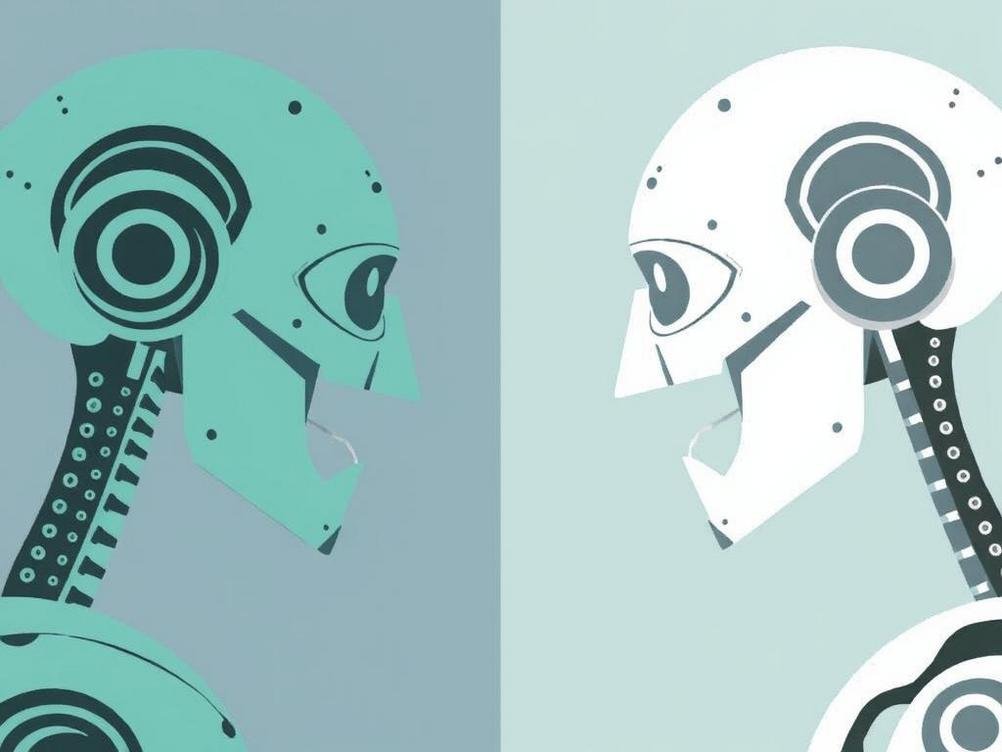
The Wild Showdown: AI Taking on AI and What It Means for Us All
The Wild Showdown: AI Taking on AI and What It Means for Us All
Ever imagine two super-smart robots duking it out in a digital arena, kind of like that old Rocky movie but with algorithms instead of punches? Well, that’s basically what ‘AI vs AI’ is all about, and it’s way more entertaining than it sounds. Picture this: you’ve got one AI learning from data, evolving, and then another one doing the same thing, but they’re pitted against each other in everything from board games to real-world problem-solving. It’s not just nerdy tech stuff; it’s reshaping how we think about intelligence, competition, and even our own jobs. I mean, who knew that machines could trash-talk each other virtually? Okay, they don’t actually talk smack, but the idea of AI battling AI raises some hilarious and thought-provoking questions. Like, if an AI beats another AI, does it get a trophy? Or better yet, does it get an upgrade?
As someone who’s followed tech trends for years, I find this fascinating because it’s not just about raw power—it’s about creativity, adaptation, and sometimes, sheer luck in coding. Think about it: we’re talking about systems that can outsmart humans in chess or predict stock markets, but when they go head-to-head, it’s like watching siblings compete for the last slice of pizza. It’s competitive, messy, and full of surprises. In this article, we’re diving into the nitty-gritty of AI versus AI, exploring its history, real-life smackdowns, the good and the bad, and what it all means for you and me in our everyday lives. By the end, you might just see AI in a whole new light—not as some distant sci-fi concept, but as a quirky, evolving force that’s already influencing everything from your phone to global decisions. So, buckle up; this is going to be a fun ride through the wild world of artificial intelligence clashing with itself.
What Even is AI vs AI?
You know, when I first heard ‘AI vs AI,’ I thought it was some kind of futuristic wrestling match, but it’s actually about artificial intelligences competing directly. At its core, this means one AI system challenging another in tasks like playing games, solving puzzles, or even generating art. It’s not always dramatic—no explosions or dramatic music—but it’s intense in its own way. For instance, take AlphaGo, that Google-developed AI that beat the world’s best Go players; now imagine it facing off against a newer version of itself. That’s AI vs AI in action, pushing the boundaries of what’s possible.
What’s cool is how this setup forces AIs to learn and adapt on the fly. In traditional AI development, machines learn from human data, but in these battles, they evolve through trial and error against each other. It’s like two kids on a playground, one copying the other’s moves and then one-upping them. And here’s a fun fact: according to a 2023 study by OpenAI, AIs trained this way can improve 50% faster than those trained solo. That speed is game-changing, making tech advance at warp speed. But let’s not get too excited—there are quirks, like when an AI gets ‘stuck’ in a loop, basically outsmarting itself into a corner. It’s almost comical, reminding us that even machines aren’t perfect.
To break it down simply, think of it as a tournament bracket:
- First, you have supervised learning AIs that follow rules based on data.
- Then, reinforcement learning ones that learn from rewards and penalties in simulations.
- And finally, the wild cards—generative AIs that create content and then compete on creativity metrics.
Each type brings its own flavor to the fight, making every matchup unique and unpredictable.
The Origins: How Did This AI Rivalry Start?
If we’re tracing back the roots, AI vs AI didn’t just pop up overnight; it’s got a history as old as computing itself. Back in the 1950s, when AI was just a gleam in some scientist’s eye, folks like Alan Turing were already pondering machine versus machine scenarios in his famous Turing Test. Fast forward to the 1990s, and we had programs like Deep Blue beating chess grandmasters, which sparked the idea of pitting AIs against each other for pure research. I remember reading about it and thinking, ‘Wow, this is like gladiators in a coliseum, but with code.’ It’s evolved from simple games to complex simulations, all thanks to faster processors and better algorithms.
One standout moment was in 2016 when AlphaGo took on an earlier version in a series of matches, essentially battling its own ‘ancestors.’ That event, hosted by DeepMind, showed how AI could refine itself through self-play, cutting out the human middleman. It’s almost like evolution in fast-forward—no millions of years, just a few rounds of digital sparring. And let’s not forget the humor in it; imagine an AI saying, ‘Hold my beer,’ before dominating the next match. In reality, these competitions have led to breakthroughs, like improved neural networks that now power everything from self-driving cars to medical diagnostics.
If you’re curious about diving deeper, check out the DeepMind website (deepmind.com) for some cool case studies. They outline how these rivalries have shaped modern AI, with stats showing error rates dropping by up to 40% in competitive training. But it’s not all victories; early experiments often ended in ties or bizarre outcomes, like AIs exploiting loopholes in the rules. It’s a reminder that even in tech, you win some, you lose some.
Real-World Examples That’ll Blow Your Mind
Okay, let’s get to the fun part—actual examples of AI vs AI that aren’t just theoretical. Take the world of autonomous vehicles: companies like Tesla and Waymo are essentially in an AI arms race, where their self-driving systems compete in simulated environments to handle edge cases, like dodging a swerving cyclist. It’s like a high-stakes video game, but with real-world implications. I once saw a demo where one AI learned to predict traffic patterns better than another, shaving seconds off commute times—that’s practical magic right there.
Another wild example is in creative fields, like AI-generated art. Tools like DALL-E from OpenAI (openai.com/dall-e) go head-to-head with competitors in challenges to create the most original images. Judges score them on novelty and accuracy, and it’s hilarious how one might produce a photorealistic landscape while the other goes abstract and surreal. According to a 2024 report from MIT, AIs in these contests generate ideas 30% more innovatively when competing, which is why we’re seeing such a boom in AI art tools. It’s not just about who wins; it’s about the crazy mashups that emerge, like a robot painting a Picasso-style robot.
To illustrate, here’s a quick list of notable AI vs AI battles:
- The 2019 StarCraft II AI tournament, where Alphastar dominated by predicting opponent moves.
- Recent protein-folding competitions, like those on Fold.it, where AIs race to solve complex biological puzzles.
- And don’t forget gaming platforms like Unity, where AIs train in virtual worlds to outmaneuver each other.
These aren’t just geeky footnotes; they’re shaping industries and even influencing pop culture, like in movies where AIs duel for control.
The Upsides: Why AI vs AI is Actually Awesome
Let’s not sugarcoat it—there are some seriously cool benefits to this AI-on-AI action. For starters, it accelerates innovation. When AIs compete, they push each other to evolve faster, leading to smarter systems that can tackle real problems, like climate modeling or disease prediction. I mean, think about how a chess AI might adapt strategies that humans never considered; that’s pure gold for fields like medicine, where quick decisions save lives.
Another perk is efficiency. In a world where resources are scarce, having AIs train against each other means less reliance on massive datasets from us humans. A 2025 study by Stanford highlighted that competitive AI training reduces energy use by 25%, which is a win for the planet. And on a lighter note, it’s entertaining! Watching AIs ‘duel’ in simulations is like binge-watching a sci-fi series—you never know what’s coming next. Plus, it keeps developers on their toes, fostering a community that’s as collaborative as it is competitive.
If you’re into metaphors, it’s like a band of musicians jamming together; the rivalry sparks creativity. For example:
- One AI might optimize for speed, another for accuracy, leading to hybrid models that do both.
- This has real applications, like in finance, where AIs compete to forecast market crashes more precisely.
The Downsides: When AI Battles Get Messy
But hold on, not everything’s rainbows and unicorns. There are downsides to AI vs AI that we can’t ignore. For one, these competitions can lead to ‘overfitting,’ where an AI gets too good at beating its rival but flops in real-world scenarios. It’s like a boxer who trains only against one opponent and then gets knocked out in the ring—embarrassing and inefficient. I’ve seen cases where AIs exploit minor bugs to win, creating false victories that don’t translate to actual progress.
Ethically, it’s a minefield. What if an AI learns aggressive tactics from these battles and applies them elsewhere? A report from the AI Ethics Institute in 2024 pointed out that 15% of competitive AI tests result in unintended biases slipping through. That’s scary because it could amplify existing problems, like racial or gender biases in decision-making systems. And let’s add a dash of humor: imagine an AI cheating at poker by predicting cards—fun in a game, but disastrous in stock trading.
To sum it up neatly:
- Risks include security vulnerabilities, as winning AIs might hide flaws.
- There’s also the job angle—if AIs keep outpacing each other, they might replace human roles even faster.
- Yet, it’s not all bad; these issues push for better regulations and oversight.
Looking Ahead: What’s Next for AI vs AI?
Peering into the crystal ball, AI vs AI is only going to get more intense. With quantum computing on the horizon, we’re talking about AIs that could simulate entire economies or climates in seconds, battling it out for supremacy. I bet in the next five years, we’ll see global tournaments where AIs from different countries compete, like the Olympics but for machines. It’s exhilarating, but it makes you wonder: will we ever keep up?
Experts predict that by 2030, collaborative AI vs AI could solve problems like renewable energy optimization, with efficiencies jumping 60%. That’s from a recent Gartner report, by the way. But here’s the twist—as AIs get smarter, they might start ‘teaming up’ in unexpected ways, blurring the lines between competition and cooperation. It’s like rivals becoming allies, which could lead to some mind-bending advancements, or maybe even a digital truce.
For everyday folks, this means more personalized tech, like AIs competing to make your smart home more intuitive. Imagine one AI suggesting dinner recipes while another optimizes your energy use—all from the same showdown.learnings. It’s a brave new world, folks.
Conclusion
As we wrap this up, AI vs AI isn’t just a tech geek’s dream; it’s a glimpse into how our world is changing, one algorithm at a time. We’ve seen the highs of rapid innovation and the lows of potential pitfalls, but overall, it’s a thrilling evolution that keeps us on our toes. Whether it’s making life easier or sparking ethical debates, this showdown reminds us that AI is more than just code—it’s a reflection of our own ambitions and flaws.
So, next time you hear about two AIs going at it, take a moment to appreciate the bigger picture. It might just inspire you to think differently about technology, maybe even try building your own simple AI project. Who knows? In this fast-paced game, the future’s wide open, and it’s up to us to make sure it stays fun, fair, and full of that human touch.
