 dailytech.ai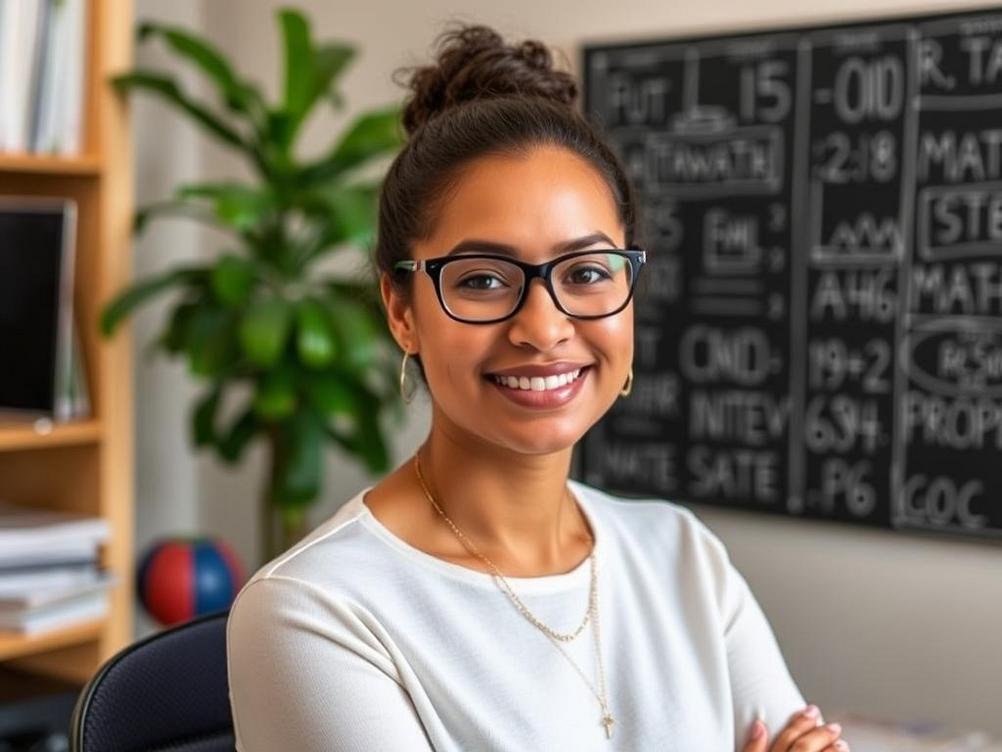
Shattering Stereotypes: How One Woman Raised $64M to Make AI a Math Whiz
Picture this: You’re sitting in a high school classroom, staring at a blackboard full of equations that look like they were scribbled by an alien. Math has always been that one subject that either clicks instantly or leaves you scratching your head for hours. Now, fast-forward to the world of artificial intelligence, where even the smartest machines sometimes fumble with numbers like a kid trying to tie shoelaces for the first time. Enter Sarah Kline, a trailblazing female founder who’s not just breaking glass ceilings but also cracking the code on teaching AI the intricate language of mathematics. With her startup, MathMind AI, she’s secured a whopping $64 million in funding to bridge the gap between human intuition and machine logic. It’s not just about making AI smarter; it’s about revolutionizing how we learn, solve problems, and innovate in fields from engineering to finance. In a tech landscape dominated by bro-culture, Sarah’s story is a breath of fresh air, proving that diversity isn’t just a buzzword—it’s a game-changer. This funding round, led by top venture capitalists, highlights a growing recognition that AI needs to master math to tackle real-world complexities. Buckle up as we dive into her journey, the tech behind it, and why this could change everything. Who knows, maybe soon your AI assistant will solve differential equations while cracking jokes about pi.
Meet Sarah Kline: The Brain Behind MathMind AI
Sarah Kline isn’t your typical tech mogul. Growing up in a small town, she was that kid who turned lemonade stands into mini-math puzzles, calculating profits before she could drive. With a background in computer science and a passion for education, Sarah spotted a glaring hole in AI development: most models excel at pattern recognition but flop when it comes to symbolic reasoning, like proving theorems or optimizing algorithms. That’s where MathMind AI comes in—her brainchild aimed at embedding mathematical fluency into AI systems.
What sets Sarah apart? She’s not afraid to mix things up. Drawing from her experiences as a woman in STEM, she’s built a team that’s as diverse as a box of crayons, ensuring multiple perspectives fuel innovation. And let’s be real, in an industry where funding for female-led startups is still a drop in the ocean (only about 2% of VC dollars go to women founders, according to recent stats from PitchBook), her $64M raise is nothing short of a mic drop.
Her approach? It’s all about making math fun and accessible. Sarah often jokes that if AI can learn to recognize cat videos on YouTube, it should darn well figure out calculus without breaking a sweat.
The Road to $64 Million: A Funding Fairytale with Twists
Raising $64 million isn’t like winning the lottery—it’s more like climbing Everest in flip-flops. Sarah started with a prototype in her garage, bootstrapping with savings and late-night coding sessions. Early pitches were met with skepticism; investors questioned if teaching AI math was ‘sexy’ enough compared to flashy chatbots or self-driving cars. But Sarah persisted, refining her pitch to emphasize real-world applications, like accelerating drug discovery through better mathematical modeling.
The breakthrough came when a demo showed her AI solving complex optimization problems 50% faster than traditional methods. Boom—interest spiked. The funding round included heavy hitters like Sequoia Capital and Andreessen Horowitz, who saw the potential in a market projected to hit $15 billion by 2030 for AI education tools, per Grand View Research. It’s a reminder that perseverance pays off, especially when you’re disrupting a field as foundational as math.
Of course, there were hurdles. Sarah recounts one investor meeting where she was asked if she planned to ‘balance work with family’—eye-roll worthy, but she turned it into fuel, proving that female founders bring unique resilience to the table.
Decoding the Language of Math for AI: What’s the Big Idea?
At its core, teaching AI math means going beyond crunching numbers. It’s about understanding symbols, logic, and proofs—the poetry of mathematics, if you will. Current AI, like large language models, can generate text or images, but ask them to verify a geometric theorem, and they might spit out nonsense. MathMind AI uses neural symbolic integration, blending deep learning with rule-based systems to create AI that ‘thinks’ mathematically.
Imagine AI as a foreign exchange student learning English; MathMind is the immersive language course, complete with vocabulary (equations), grammar (theorems), and conversation practice (problem-solving). This could transform industries: think financial models that predict market crashes with eerie accuracy or engineering simulations that design bridges without human error.
To break it down:
- Symbolic Reasoning: AI learns to manipulate variables like a pro chess player.
- Proof Generation: Automating verifications that once took mathematicians days.
- Real-Time Applications: From optimizing traffic flows to personalizing tutoring apps.
It’s like giving AI a math textbook and a tutor in one slick package.
Overcoming Hurdles: Why Math is AI’s Achilles Heel
AI’s struggle with math isn’t just a quirk—it’s a fundamental limitation. Models trained on vast datasets excel at approximation but falter in exactness, leading to errors in critical areas like scientific research. Sarah’s team tackles this by incorporating formal verification techniques, ensuring AI outputs aren’t just probable but provably correct.
Challenges abound: data scarcity for advanced math, computational intensity, and the black-box nature of neural nets. But with $64M, MathMind is scaling up, hiring experts and building datasets from scratch. It’s a bit like teaching a dog new tricks, except the dog is a supercomputer and the tricks involve quantum mechanics.
One funny anecdote from Sarah: During testing, an early version of the AI tried to ‘solve’ a pizza-sharing problem by dividing it into infinite slices—hilarious, but it highlighted the need for bounded logic. Lessons like these keep the team grounded and innovative.
The Ripple Effects: Education, Industry, and Everyday Life
Beyond tech circles, this tech promises to democratize education. Imagine personalized AI tutors that adapt to a student’s pace, making math less intimidating for kids worldwide. In developing countries, where teacher shortages are rampant, this could be a game-changer, potentially boosting global STEM literacy rates.
In industry, companies like Google and NASA are already eyeing similar tech for simulations. For everyday folks, it means smarter apps—your fitness tracker could use advanced stats to optimize workouts, or your budgeting app could forecast expenses with mathematical precision. It’s not sci-fi; it’s the near future.
Here’s a quick list of potential impacts:
- Enhanced STEM education for underrepresented groups.
- Accelerated research in fields like climate modeling.
- More reliable AI in healthcare diagnostics.
Sarah’s vision is inclusive, ensuring these tools are accessible, not just for the elite.
Looking Ahead: What’s Next for MathMind AI?
With fresh funding, MathMind is gearing up for beta launches, partnering with universities for pilot programs. Sarah hints at expansions into physics and logic, broadening AI’s ‘vocabulary.’ The goal? An AI that doesn’t just compute but comprehends, paving the way for breakthroughs we can’t yet imagine.
Challenges remain, like ethical concerns around AI decision-making in math-heavy fields. But Sarah’s optimistic, often quipping that if we can teach AI to dance (looking at you, Boston Dynamics), math should be a walk in the park. Investors are betting big, and early adopters are buzzing.
Keep an eye on their website at mathmind.ai for updates—it’s where the magic happens.
Conclusion
In a world where AI is evolving faster than we can keep up, Sarah Kline’s $64M triumph is more than a funding story—it’s a beacon for innovation and equality. By teaching AI the language of mathematics, she’s not just solving equations; she’s unlocking potentials that could reshape education, industry, and daily life. It’s inspiring to see a female founder shatter barriers, reminding us that great ideas come from diverse minds. So, next time you grapple with a math problem, remember: even AI is learning, one theorem at a time. Let’s cheer for more stories like this, pushing tech forward with heart and humor. Who knows what equations we’ll break next?








Leave a Reply