
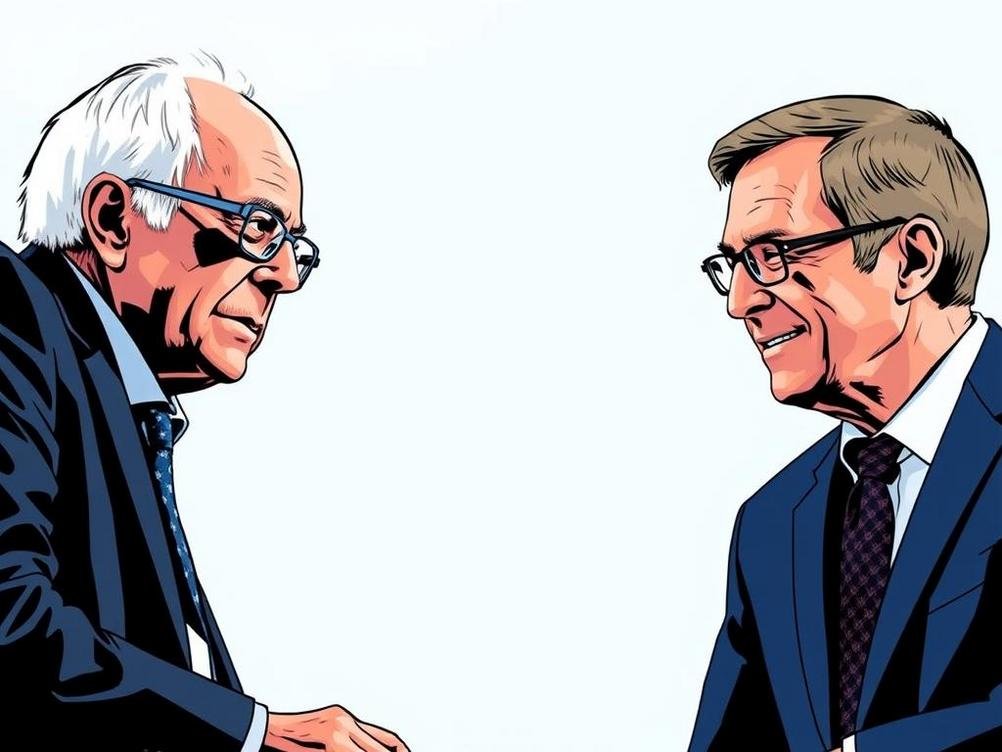
5 Game-Changing Insights from Bernie Sanders and Geoffrey Hinton’s Epic AI Debate at Georgetown
5 Game-Changing Insights from Bernie Sanders and Geoffrey Hinton’s Epic AI Debate at Georgetown
Imagine sitting in a packed hall at Georgetown University, popcorn in hand (okay, maybe not, but wouldn’t that be fun?), listening to Bernie Sanders, the fiery senator who’s always fighting for the little guy, and Geoffrey Hinton, the godfather of AI himself, going head-to-head on the wild world of artificial intelligence. I stumbled upon this conversation online the other day and, wow, it got me thinking about how AI is reshaping everything from our jobs to our ethics. It’s like watching a blockbuster movie where tech meets politics, and the stakes are sky-high. Picture this: Hinton, who’s basically the dude who helped invent the stuff that’s powering your smartphone’s creepy ability to predict what you’re about to type, and Sanders, who’s all about calling out inequality, hashing out whether AI is going to be our savior or our downfall. It’s not just geeky talk; it’s real stuff that affects you and me every day. From the way AI could flip the job market on its head to the moral minefields we’re stepping into, this chat was a wake-up call. I mean, who knew that a conversation between a tech wizard and a progressive politician could make you rethink your entire stance on technology? Stick around, because I’m breaking down what I learned, and trust me, it’s eye-opening in a ‘holy cow, what have we created?’ kind of way. We’ll dive into the nitty-gritty, sprinkle in some real-world examples, and maybe even throw in a laugh or two because, let’s face it, AI’s got some hilariously awkward moments too.
The Hype Around AI: Is It All Smoke and Mirrors?
Okay, let’s kick things off with the big question: What’s all the fuss about AI anyway? During their chat, Hinton dove into how AI has exploded from a niche lab experiment to something that’s everywhere, like that friend who shows up uninvited to every party. He talked about neural networks and machine learning like they were no big deal, but Sanders was quick to point out that not everyone’s riding this wave. It’s kinda like when your grandma tries to use TikTok – exciting, but also a bit messy. From what I gathered, AI isn’t just about fancy robots; it’s about algorithms that learn from data, making decisions faster than you can say “autocomplete.”
One thing that stood out was Hinton’s take on how AI’s gotten so good at pattern recognition. Think about it: Tools like ChatGPT or Google’s Bard (which you can check out at bard.google.com) are basically sucking up massive amounts of info to spit out answers that feel almost human. But Sanders wasn’t having it; he pushed back, saying this hype machine could leave folks behind, especially in places where tech access is spotty. And honestly, he’s got a point – according to a 2024 report from the World Economic Forum, about 85 million jobs could be displaced by AI by 2025, but it might also create 97 million new ones. That’s a net win, sure, but only if we’re prepared. I remember laughing when Hinton joked that AI could handle his emails, but Sanders shot back that it better not replace the postal workers he fights for. It’s a reminder that AI’s potential is real, but so are the pitfalls if we don’t handle it right.
- First off, AI’s strengths lie in automation, like self-driving cars from companies like Tesla.
- But don’t forget the risks, such as bias in algorithms, which a study from MIT showed can perpetuate inequality if not checked.
- And hey, on a lighter note, AI’s also behind those viral deepfakes – remember that one of Tom Cruise? Hilarious, until it’s not.
AI’s Impact on Jobs: Will Robots Steal Your Lunch?
If there’s one thing Sanders hammered home, it’s how AI could turn the job market into a game of musical chairs, and not everyone might get a seat. Hinton admitted that yeah, AI automation is coming for repetitive tasks, but he argued it could free us up for more creative stuff. Picture a factory worker who used to bolt widgets all day; now, with AI robots handling that, they could move into designing the next big thing. But Sanders wasn’t buying the optimism wholesale – he pointed to examples like Amazon warehouses, where AI-driven efficiency has led to tougher conditions for humans. It’s like that old saying, ‘Don’t put all your eggs in one basket,’ except here the basket is the economy.
From my perspective, this conversation highlighted a real divide. Statistics from the Brookings Institution show that about 25% of U.S. jobs are at high risk of automation, particularly in low-wage sectors. That’s scary if you’re in retail or manufacturing, but it could be a boon for fields like healthcare or education. For instance, AI tools like IBM’s Watson (visit www.ibm.com/watson) are already helping doctors diagnose diseases faster, potentially saving lives. Still, Sanders made a solid case for retraining programs, arguing that governments need to step in before AI leaves a generation in the dust. I chuckled thinking about how AI might replace my barista, but then I’d miss that perfect foam art – some things just need a human touch, you know?
- Jobs most at risk: Data entry, customer service roles – think chatbots taking over.
- Opportunities ahead: AI could spark growth in creative industries, like using tools from Adobe for enhanced design work.
- And let’s not overlook the funny side: Ever seen those AI-generated job listings that sound like they’re from another planet?
Ethical Dilemmas: When AI Gets Too Smart
Things got pretty intense when they talked ethics – Hinton opened up about the ‘black box’ problem, where AI makes decisions we don’t fully understand. It’s like having a teenager who won’t explain why they stayed out late; frustrating and a bit dangerous. Sanders jumped in with concerns about privacy and bias, referencing how facial recognition tech has disproportionately affected people of color, as reported by the ACLU. He pushed for more accountability, and honestly, it’s a conversation we all need to have before AI starts calling the shots.
One metaphor Hinton used was comparing AI to a wild horse – powerful, but hard to control without the right reins. For example, tools like OpenAI’s GPT models (check out openai.com) have led to amazing advancements, but they’ve also been used to spread misinformation. Sanders advocated for regulations similar to those in the EU’s AI Act, which aims to classify high-risk AI systems. I found myself nodding along, thinking about how we’ve got to balance innovation with protecting our rights. It’s not just about tech; it’s about making sure AI doesn’t amplify existing inequalities, like in hiring algorithms that favor certain demographics.
- Key ethical issues: Data privacy breaches, as seen in the Cambridge Analytica scandal.
- Potential solutions: Implementing diverse teams in AI development to reduce bias.
- A humorous take: AI ethics is like teaching a computer manners – it might say ‘please’ and ‘thank you,’ but does it mean it?
Government’s Role: Should We Regulate AI Like Traffic Lights?
Sanders was in his element here, arguing that without government oversight, AI could run amok like a kid with too much candy. Hinton, ever the optimist, suggested self-regulation by tech companies, but even he conceded that might not cut it. It’s akin to letting drivers set their own speed limits – sounds good until someone crashes. They discussed how countries like China are forging ahead with AI without much pushback, while the U.S. lags behind, and that got me wondering if we’re sleeping on the wheel.
From real-world insights, the Biden administration’s executive order on AI safety in 2023 is a step in the right direction, aiming to ensure responsible development. Sanders emphasized funding for public AI initiatives, so it’s not just big corps calling the shots. I appreciated Hinton’s point that over-regulation could stifle innovation, like putting a leash on a racehorse. But let’s be real, if AI’s going to influence elections or healthcare, we need rules – otherwise, it’s chaos. Picture this: AI deciding loan approvals without human oversight? No thanks.
- Pros of regulation: Prevents misuse, as in the case of deepfake videos in elections.
- Cons: Might slow down progress, like delaying life-saving medical AI.
- Fun fact: Sanders likened it to regulating social media – we know it’s needed, but it’s a headache.
The Future of AI: Utopian Dream or Dystopian Nightmare?
Wrapping up their discussion, both agreed that AI’s future hinges on how we steer it. Hinton painted a picture of AI augmenting human capabilities, like enhancing education through personalized learning apps. Sanders, though, warned of a dystopian scenario where the wealthy hoard AI benefits, leaving the rest scrambling. It’s like that sci-fi movie where robots take over, but with a twist – we’re the ones programming them.
Looking at stats, a PwC report predicts AI could add $15.7 trillion to the global economy by 2030, but only if we address the gaps. For everyday folks, that means better tools for everything from farming to art. I loved how Hinton shared anecdotes from his career, like working on projects that evolved into today’s voice assistants. Sanders countered with stories of workers displaced by tech, urging a more equitable path. In the end, it’s about choices – do we build AI that lifts everyone or just the elite?
- Positive outlook: AI in climate change, like predictive models for weather patterns.
- Negative risks: Job losses and surveillance overreach.
- My two cents: Let’s make AI the sidekick, not the superhero.
Conclusion: What This Means for You and Me
So, after diving into Bernie Sanders and Geoffrey Hinton’s conversation, it’s clear that AI isn’t just some far-off tech – it’s already weaving into our lives, for better or worse. From the job shifts to the ethical tightropes, this chat reminded me that we’re at a crossroads, and it’s up to us to guide things. Whether it’s pushing for better regulations or just being savvy consumers, we all have a role. I came away inspired, thinking about how we can harness AI’s power without losing our humanity. Let’s keep the conversation going, because in the end, it’s not about fearing the future; it’s about shaping it. Who knows, maybe one day we’ll look back and laugh at how worried we were – or maybe we’ll be thanking Sanders and Hinton for the heads-up.
