dailytech.ai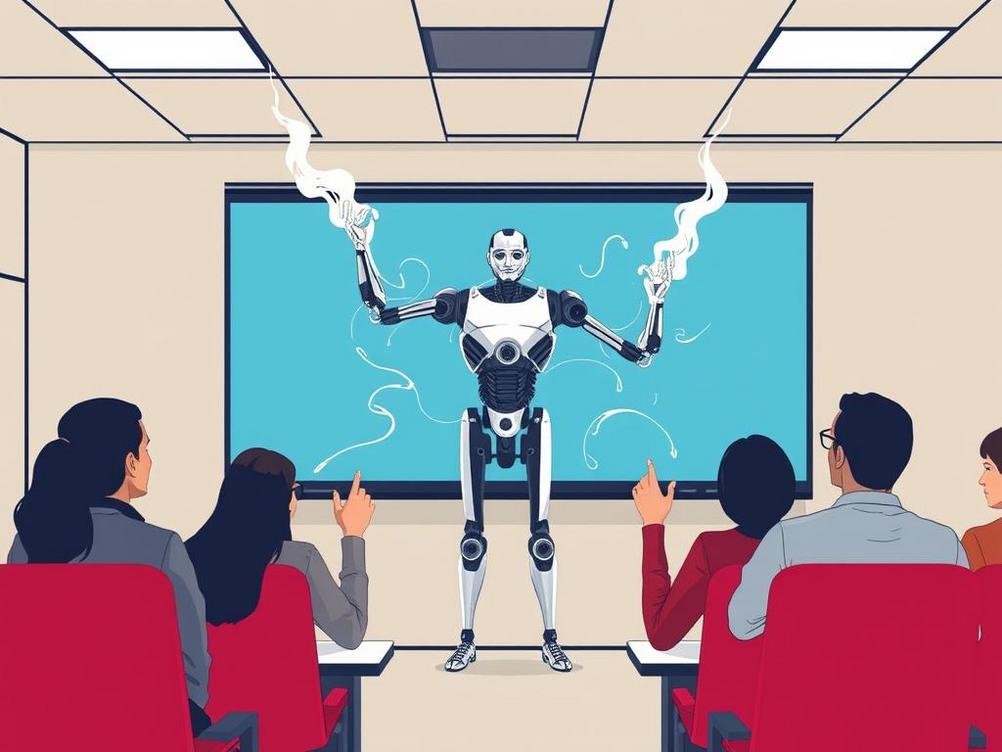
Why Students Are Rebelling Against AI Teachers: The Staffordshire University Drama
You ever sit in a class and think, ‘Wait, is this teacher even human?’ Well, that’s exactly what happened at Staffordshire University, where students are up in arms over a course that’s basically being run by AI. Picture this: you’re paying good money for an education, and instead of a quirky professor with wild stories, you’re staring at a screen that might as well be ChatGPT in a bad wig. It’s sparked a real debate about whether machines can ever replace the human touch in learning. As someone who’s seen tech take over everything from shopping to dating, I can’t help but chuckle at the irony – we created AI to make life easier, but now it’s ruffling feathers in the classroom. This whole fiasco isn’t just about one university; it’s a wake-up call for how AI is reshaping education, for better or worse. We’re talking about the pros, the cons, and why students feel like they’re being shortchanged. Stick around, and let’s dive into this mess – because if AI starts grading our essays, who knows what’s next? Maybe it’ll decide our futures based on how well we flatter it. By the end, you’ll see why blending tech with teaching isn’t as straightforward as it seems, and how we can make it work without losing that personal spark.
The Buzz Around Staffordshire University’s AI Experiment
It all kicked off when students at Staffordshire University found out their course was being partially taught by AI, and boy, did they let their voices be heard. Reports say the university rolled out this AI-driven module to handle lectures and maybe even some tutoring, thinking it was a shiny new way to modernize education. But students weren’t having it – they started a petition and even protested, arguing that it felt impersonal and, as one student famously put it, ‘We could have just asked ChatGPT.’ It’s like inviting a robot to your party and expecting everyone to dance. I mean, imagine paying for a degree and getting auto-generated responses instead of real debates. This isn’t just a one-off gripe; it’s highlighting how quickly AI is infiltrating our lives, especially in places like universities where human interaction is key.
From what I’ve read, the university defended the move by saying it frees up human teachers for more complex stuff, like one-on-one mentoring. But let’s be real, there’s something magical about a professor who can share personal anecdotes or crack a joke mid-lecture. AI might spit out facts faster than you can say ‘algorithm,’ but it lacks that emotional intelligence. Think of it like comparing a microwave dinner to a home-cooked meal – both fill you up, but one leaves you wanting more. Statistics from a 2024 study by the Higher Education Policy Institute show that over 60% of students prefer human-led classes for subjects involving critical thinking, which makes this backlash totally understandable. If you’re curious, you can check out the study at their website. All this has put Staffordshire under the spotlight, raising questions about accountability and whether AI is ready for prime time in education.
Adding to the drama, social media blew up with memes and threads about the incident, turning it into a viral moment. Students shared stories of AI mix-ups, like when it gave completely wrong historical dates or failed to answer nuanced questions. It’s almost comical, but it’s also a reminder that AI isn’t infallible – far from it. We’ve all had moments where Siri or Alexa lets us down, so why trust it with our education? This event is a prime example of how tech experiments can backfire if not handled with care, and it’s forcing universities worldwide to rethink their strategies.
The Upsides of Letting AI Step into the Classroom
Okay, before we get too worked up, let’s give AI its due – it’s not all bad in education. Think about it: AI can personalize learning like nothing else. For instance, tools like Duolingo or Khan Academy use AI to adapt to your pace, making sure you’re not bored out of your mind with stuff you already know. At Staffordshire, the university probably saw this as a way to reach more students efficiently, especially with growing class sizes. It’s like having a tutor that never sleeps or gets crabby – AI can grade papers in seconds, provide instant feedback, and even suggest resources tailored to your needs. According to a report from Gartner in 2025, AI integration in education could boost student engagement by up to 30%, which is huge when you’re dealing with diverse learning styles.
One cool example is how AI-powered platforms like Coursera’s adaptive learning systems help folks in remote areas access top-notch courses. You could be in a tiny town and still learn from Ivy League material – that’s pretty empowering. I’ve used AI tools myself for quick research, and it’s a game-changer for organizing information. But here’s the thing: it’s best as a sidekick, not the main act. Imagine AI as that reliable friend who helps with homework but isn’t invited to the sleepover. If universities play their cards right, AI could handle repetitive tasks, letting human teachers focus on the fun parts, like sparking debates or mentoring. The key is balance, right? Otherwise, we risk turning education into a sterile, click-through experience.
- Personalized learning paths that adjust to individual progress.
- 24/7 availability for questions and support.
- Automated grading that saves time for both students and teachers.
- Access to vast resources and data analytics to track performance.
Why Students Are Pushing Back: The Human Factor
Now, let’s talk about the flip side – why students at Staffordshire and elsewhere are saying ‘no thanks’ to AI teachers. It’s simple: education isn’t just about facts; it’s about connection. Students want to feel heard, to have discussions that go off-script, and to get advice that comes from real-life experience. When an AI takes over, it feels like talking to a wall – efficient, maybe, but not exactly inspiring. One student quoted in the media said it felt like ‘learning from a chatbot,’ which hits the nail on the head. We all know AI can hallucinate or give biased responses, and that’s a big risk when you’re shaping young minds.
From my perspective, this backlash is about trust. A 2025 survey by Educause revealed that 75% of college students worry about AI’s accuracy and potential for misinformation. That’s scary when you’re relying on it for your degree. Plus, there’s the humor in it – like when AI tries to relate and ends up sounding robotic. ‘Hey, kid, life’s like a probability algorithm!’ Yeah, not exactly motivational. Students at Staffordshire highlighted how AI couldn’t handle cultural nuances or emotional support, which is crucial in fields like psychology or literature. It’s like asking a calculator to write poetry – it might rhyme, but it won’t have soul.
- Missing out on human empathy and interactive discussions.
- Concerns over job losses for teaching staff.
- Fear of reduced critical thinking skills from over-reliance on AI.
The Bigger Picture: AI’s Role in Shaping Education’s Future
Zooming out, this Staffordshire drama is just a chapter in the larger story of AI’s evolution in education. We’re seeing a global shift, with countries like the US and UK investing billions in edtech. For example, the UK’s Department for Education announced in 2024 a plan to integrate AI into curriculums, aiming to prepare students for a tech-driven world. But as this incident shows, it’s not all smooth sailing. AI could revolutionize how we learn, making education more accessible and efficient, yet we need to address the pitfalls head-on.
Take tools like Grammarly or Google’s Bard – they’re great for editing essays or brainstorming ideas, but they shouldn’t replace teachers. I’ve used them to polish my writing, and it’s helpful, but it doesn’t teach me why something works; that’s where humans shine. A metaphor I’ve always liked is AI as a co-pilot in a plane – useful for navigation, but you’d never let it fly solo. Forward-thinking universities are experimenting with hybrids, like AI-assisted flipped classrooms, where students prep with tech and discuss with people. If we don’t get this right, we might end up with a generation that’s tech-savvy but lacks interpersonal skills.
How to Strike a Balance: Tips for Universities and Students
So, how do we fix this? Universities need to listen more and integrate AI thoughtfully. At Staffordshire, maybe starting with pilot programs and gathering student feedback could have avoided the uproar. It’s about using AI for what it does best – data analysis, simulations, or even virtual labs – while keeping human instructors in the loop. For students, learning to work with AI is a skill in itself. Think of it as teaching an AI to be your ally, not your enemy. Tools like Microsoft’s Learning Tools or IBM’s Watson for education can be fantastic if used wisely.
Here’s a practical list to get started: First, demand transparency from your school about AI use. Second, practice critical thinking by fact-checking AI outputs. And third, advocate for blended learning models. I remember when online classes boomed during the pandemic – it was a mess at first, but we adapted. This is no different; with some tweaks, AI could enhance education without overshadowing it. Check out resources from the UK’s education site for more on best practices.
- Encourage hybrid models that combine AI and human teaching.
- Train educators on ethical AI use.
- Involve students in decision-making processes.
Real-World Insights and What We’ve Learned So Far
Looking at other examples, like how MIT uses AI for coding courses, we see successes and failures. Their platform adapts to student errors in real-time, which is genius, but they’ve also faced complaints about over-dependence. A 2025 report from UNESCO states that AI could bridge educational gaps in developing countries, potentially reaching millions more learners. Yet, cases like Staffordshire remind us that cultural and ethical considerations matter. It’s like adding spice to a recipe – too much, and it’s overwhelming; just right, and it’s delicious.
In my own experience, AI has helped me research topics for articles, but I always double-check and add my personal flair. That’s the secret: use AI as a springboard, not a crutch. With AI expected to influence 50% of global education by 2030, according to McKinsey, we need to evolve smartly. Otherwise, we might create a world where learning feels like a scripted video game.
Conclusion
Wrapping this up, the Staffordshire University saga shows we’re at a crossroads with AI in education – it’s exciting, messy, and full of potential pitfalls. Students fighting back isn’t just whining; it’s a push for better, more human-centered learning. We’ve explored the pros, like personalized tools, and the cons, like losing that personal touch, and it’s clear we need a balanced approach. As we move forward, let’s remember that education is about growth, not just efficiency. Whether you’re a student, teacher, or just curious, keep questioning how tech fits into your world – it could lead to some pretty innovative changes. Who knows, maybe one day AI will teach us something profound, but for now, let’s keep the humans in the driver’s seat.